Do Kids Still Need to Learn Coding and Math in the AI Era?
Marc Andreessen explains why AI makes foundational knowledge more important, not less

Marc Andreessen has a message that cuts against the growing narrative in education circles: AI doesn’t eliminate the need for kids to learn coding and math. It makes that learning more critical than ever.
In a recent conversation on Lenny’s Podcast, the Netscape founder and a16z co-creator laid out why the question “Do we still need to teach these skills?” misunderstands what’s actually happening with AI and abstraction.
The Pattern That Keeps Repeating
Andreessen frames AI as just the latest abstraction layer in a long line of technological shifts that have repeatedly redefined what it means to be a programmer, or a problem-solver, or a knowledge worker.
"AI coding actually abstracts away the process of actually writing the scripting code... This is the next layer of the task redefinition under the job of programmer."
Marc Andreessen
Think about it: programmers once toggled switches to input machine code. Then came assembly language. Then compiled languages. Then scripting languages. Then frameworks and libraries.
Each layer abstracted away complexity. Each time, people worried the job would disappear. Each time, it evolved upward instead.
The best programmers today aren’t being replaced. They’re already adapting, even if their day-to-day looks radically different now.
What Elite Programmers Are Already Doing
Andreessen frames AI as just the latest abstraction layer in a long line of technological shifts that have repeatedly redefined what it means to be a programmer, or a problem-solver, or a knowledge worker.
"The world's best programmers today will tell you, 'My job is I'm sitting there and I'm orchestrating 10 code bots running in parallel.' Their day job now is kind of arguing with the AI bots to try to get them to write the right code."
Marc Andreessen
They’re no longer spending hours writing boilerplate or debugging syntax errors. They’re directing multiple AI agents simultaneously, coordinating complex systems, and solving higher-order architectural problems.
The task changed. The job leveled up.
Why Fundamentals Matter More, Not Less
Here’s where Andreessen makes a crucial point that cuts against the “just let AI do it” mentality spreading in some education circles:
"You need to still fully understand and learn how to write and understand code, because if it doesn't work or it's not doing what you expect, you need to be able to understand the results of what the AI is giving you."
Marc Andreessen
He draws a direct parallel: just as someone writing scripting languages still needs to understand how a microprocessor works, someone orchestrating AI bots needs to understand the code those bots produce.
"It's this upleveling of capability where you actually want the depth to go down and understand what the thing is actually doing, even if you're not spending your day doing that by hand."
Marc Andreessen
Without that depth, you can’t evaluate output. You can’t spot subtle bugs. You can’t make good architectural decisions. You become a prompt writer, not a programmer.
What “Knowing Math” Actually Means
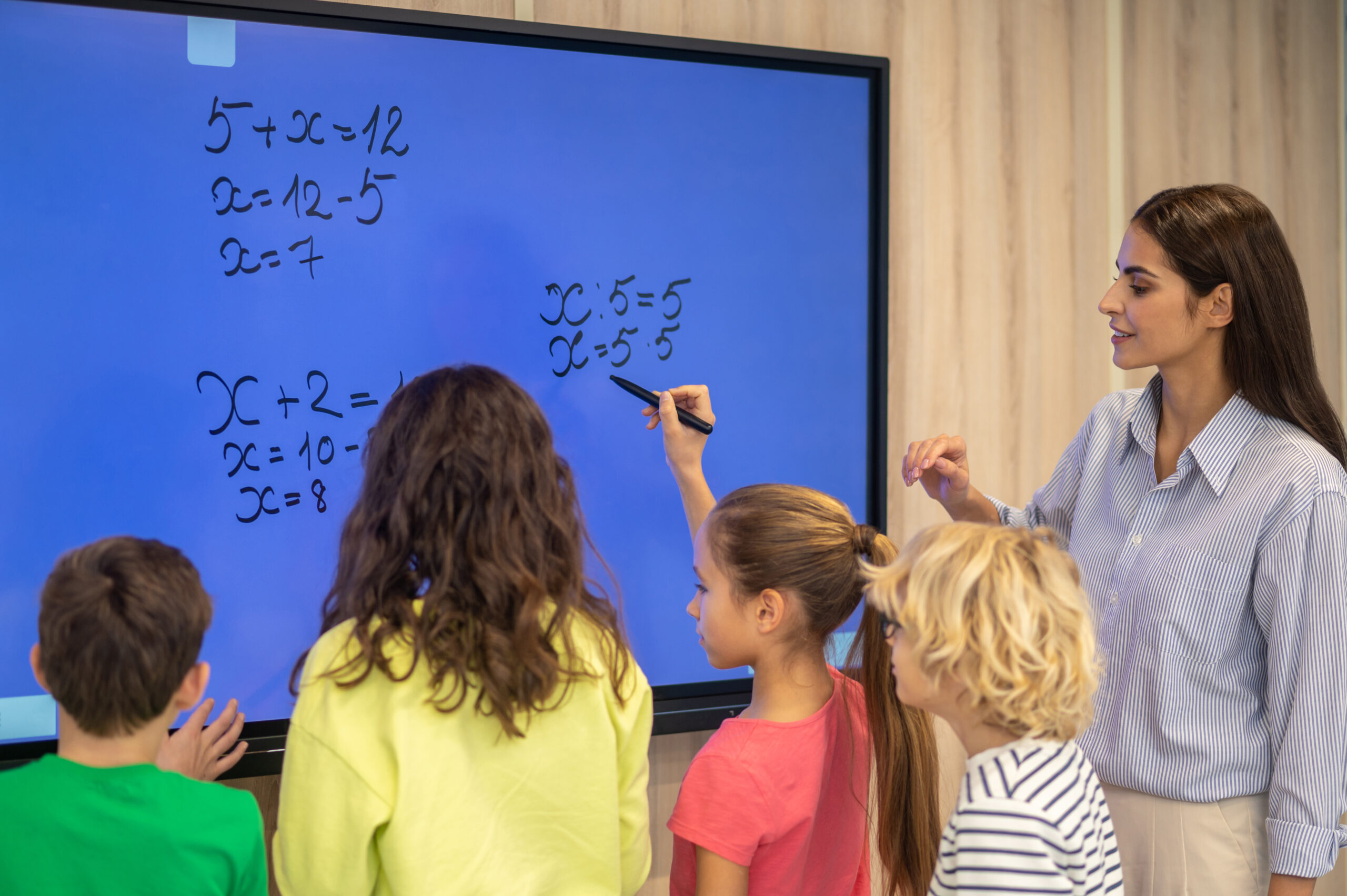
When we say “teach kids math,” we’re not really talking about making them human calculators. We never were.
We’re teaching them:
- Quantitative reasoning: How to think about relationships between quantities
- Problem decomposition: Breaking complex problems into manageable pieces
- Pattern recognition: Seeing structure in chaos
- Logical thinking: Following chains of reasoning to conclusions
- Estimation and sanity checking: Knowing when an answer “feels wrong”
These capabilities don’t evaporate because AI can execute calculations. They become the interface through which a human directs AI effectively.
A child who never learned to estimate, to think proportionally, or to recognize mathematical patterns won’t suddenly gain those abilities by typing prompts into ChatGPT. They’ll be unable to evaluate whether the AI’s output makes sense.
The “Orchestration” Skill Starts Early
Andreessen describes elite programmers as now “orchestrating 10 code bots running in parallel.” That’s not a skill you develop overnight when you’re handed AI tools.
It emerges from:
- Deep understanding of what good code looks like
- Ability to decompose problems into components
- Judgment about architecture and design
- Recognition of subtle bugs and edge cases
Similarly, a student who learns math deeply develops the judgment to:
- Frame problems clearly for AI to solve
- Recognize when AI has misunderstood the question
- Verify outputs using different methods
- Apply solutions appropriately in context
You can’t orchestrate what you don’t understand.

The Dangerous Shortcut
There’s a seductive logic to “just let AI handle it”:
Kids struggle with math → AI solves math easily → Skip the struggle
But this misunderstands what the struggle builds. The difficulty is not a bug; it’s the feature.
Wrestling with a coding problem teaches:
- Debugging (systematic problem-solving under constraints)
- Persistence through frustration
- Breaking down ambiguous requirements
- Testing and validation thinking
Struggling through a proof in geometry teaches:
- Logical argumentation
- Recognizing what needs to be demonstrated versus assumed
- Building rigorous chains of reasoning
These meta-skills transfer across domains. A student who never develops them because “AI can do it” will lack the cognitive tools to direct AI effectively, or to think clearly when AI isn’t available or appropriate.
Andreessen’s View on Education and AI
Interestingly, Andreessen homeschools his 10-year-old, and AI tutoring is central to their approach. He points to research showing that one-on-one tutoring can move a student from the 50th percentile to the 99th percentile (the “Bloom 2-Sigma effect”).
“AI provides the very real prospect of being able to do that,” he explains. “If you have a kid that’s super interested in something and they can talk to an LLM about it, and they can ask an infinite number of questions and they can get instantaneous feedback… people can just do this today.”
The Productivity Explosion Ahead
If Andreessen’s thesis holds, we’re on the edge of a massive productivity shift:
"Now programmers are going to be 10 times or 100 times or a thousand times more productive. And that is overwhelmingly a good thing."
Marc Andreessen
This isn’t hyperbole if you accept the pattern:
New abstraction layer emerges → tasks change → job gets redefined upward → productivity explodes
We’ve seen it before. A single developer today can build what would have required a team of ten or twenty developers in the 1990s. The next leap could be even larger.
What Changes, What Doesn’t
So what should change about how we teach these subjects in the AI era?
What should change:
- Reduced emphasis on rote calculation and syntax memorization
- More focus on problem formulation and solution evaluation
- Earlier introduction to working with AI as a tool
- Teaching students to verify, challenge, and iterate on AI outputs
- Emphasis on judgment, taste, and design thinking
What shouldn’t change:
- Building foundational understanding of core concepts
- Developing problem-solving persistence and debugging mindset
- Learning to think logically and reason rigorously
- Practicing pattern recognition and abstraction
- Building the depth to evaluate whether solutions make sense
AI as the Philospher’s Stone
Andreessen offers a powerful metaphor for what AI represents:
"Isaac Newton was obsessed with alchemy, the transmutation of lead into gold... He spent decades trying to figure out this thing called the philosopher's stone, which would transmute the common thing into the rare thing, lead into gold. He never figured it out.""Now we literally, with AI, have a technology that transfers sand into thought. The most common thing in the world, which is sand, converted into the most rare thing in the world, which is thought. AI is the philosopher's stone."
Marc Andreessen
If AI truly is the philosopher’s stone, then the students who understand how to wield it, who can evaluate its outputs, who have the foundational knowledge to direct it effectively, will be the ones who thrive.
The Ultimate Question
Here’s the reframe:
We don’t teach kids to code and do math because we need them to be human computers. We teach them because these disciplines build thinking tools that compound over a lifetime.
The student who deeply understands code can direct AI agents. The student who only prompts AI without understanding is at its mercy, unable to judge output, spot errors, or even formulate good problems.
The student who understands mathematical reasoning can use AI to accelerate their work. The student who outsourced all mathematical thinking to AI never developed the reasoning capacity in the first place.
Andreessen’s programmers who now “orchestrate 10 code bots” aren’t doing that instead of understanding code. They’re doing it because they understand code deeply.
The kids learning to code and do math today are building the foundation to orchestrate 100 AI agents tomorrow.
Are You Building the Depth?
The question every educator, parent, and student should be sitting with:
Are you building the depth to evaluate what AI gives you, or just accepting the output?
The question isn’t whether to teach these skills. It’s whether we’re teaching them in ways that build genuine understanding, not just procedural compliance.

What’s your take? Are we teaching math and coding in ways that prepare students for an AI-augmented future? Or are we still optimizing for a world that no longer exists?
Source: This article draws from Marc Andreessen’s appearance on Lenny’s Podcast, where he discussed AI, education, productivity, and the future of work. All quotes are transcribed from that conversation.