Globe

Where CTE Meets the Real World: Robotics, Data, and Project-Based Learning

Career and Technical Education (CTE) is having a moment.  And honestly? It’s about time.

Across the US, new funding is pouring into programs that focus on workforce readiness, industry-aligned skills, and learning that actually looks like the real world. Translation? Fewer worksheets. More doing. Less theory floating in isolation. More problem-solving with purpose.

So the big question becomes:
What does “real-world learning” actually look like in a classroom?

Group of students laboratory lab in science classroom

That’s exactly where KaiLab fits.

KaiLab isn’t a single robot or a one-off activity you try once and move on from. It’s a project-based learning ecosystem built for middle and high school students, where coding, robotics, AR/VR, IoT, and data collide on purpose.

Let’s zoom out for a second… then zoom way in.

Why CTE Funding Is Shifting (and Why Schools Should Care)

If you look closely at where CTE funding is going through Perkins V, state workforce initiatives, and regional industry partnerships you’ll see a clear pattern.

The focus is on:

  • Career pathways, not isolated courses

  • Industry 4.0 skills (automation, data, sensors, AI, robotics)

  • Project-based and work-based learning

  • Collaboration, communication, and problem-solving

Middle and high schools are being asked a tough but important question:

How do we help students explore real careers before they ever have to choose one?

Education leaders increasingly agree that middle school is an ideal time to invest in CTE, when students are curious, open to exploration, and beginning to form real-world interests.

CTE today isn’t just “shop class, but modern.” It’s systems thinking. It’s understanding how technology, people, and infrastructure work together. It’s seeing how decisions ripple through an entire system.

That’s the mindset KaiLab was built for.

Middle schoolers collaborating using KaiLab with Mars Adventure Mat_with CTE posters in the classroom (Medium)

KaiLab + CTE = Learning That Actually Looks Like Work

Using large‑format adventure mats, physical robots, virtual environments, and live sensor data, KaiLab immerses students in authentic, job‑aligned challenges.

Students don’t just learn to code.
They use code to solve problems professionals actually face.

Each KaiLab mat naturally maps to high-growth CTE pathways, giving students a chance to explore industries through hands-on, meaningful projects. Instead of simulating work with worksheets, students practice the thinking, communication, and problem‑solving behaviors of the workplace.

Mars Discovery Mat: Space, Engineering, and Systems Thinking

There has literally never been a better time to learn about space.

With Artemis missions, Mars exploration, satellite networks, and private companies reshaping the space industry, students are already curious. The Mars Discovery Mat gives that curiosity somewhere to land.

Students tackle missions like:KaiLab Mars Mat

  • Navigating unfamiliar terrain autonomously
  • Testing sensors and collecting environmental data
  • Managing limited resources
  • Designing missions collaboratively

This isn’t sci-fi fluff. It mirrors real careers in: 

  • Aerospace engineering
  • Robotics and automation
  • Environmental monitoring
  • Data science

And one lesson becomes clear very quickly:
Space exploration isn’t about one robot, it’s about systems working together under constraints.

That’s exactly the kind of thinking modern CTE programs aim to build.

Autonomated Warehouse Mat: Manufacturing, Logistics, and Automation

If you want a straight line to employability, follow logistics.

Manufacturing and supply chains are being transformed by automation, robotics, and data-driven decision-making. The Autonomated Warehouse Mat drops students right into that world. 

They explore:KaiLab AR VR Warehouse Adventure Mat

  • Warehouse navigation and optimization
  • Autonomous vehicles and routing
  • Inventory flow and bottlenecks
  • Human-robot collaboration

Suddenly, “coding” isn’t abstract anymore.
It’s how packages arrive on time.
How factories stay efficient.
How small errors turn into big costs.

That’s CTE gold.

Smart City Mat: Urban Planning, Transport, and Emerging Tech

How do we design the cities of the future?

Not as a thought experiment, but for real.

On the Smart City Mat, students wrestle with big, messy decisions: KaiLab AR VR Smart City Adventure Mat

  • Autonomous vehicles, public transport, and flying taxis


  • Drones for delivery, inspection, and emergency response


  • Energy use, efficiency, and sustainability


Yes, SpaceX comes up. Flying taxis too. And yes, we already use drones everywhere.

With KaiLab’s VR environments, students can:

  • Navigate multiplayer virtual spaces (just like piloting a drone)


  • Test routes and safety constraints


  • Understand spatial awareness and control systems


They’re not just coding vehicles.
They’re debating which systems make sense—and why.

Water Cycle Mat: Infrastructure, Climate, and Disaster Response

Water is one of the most complex and often invisible systems in any city.

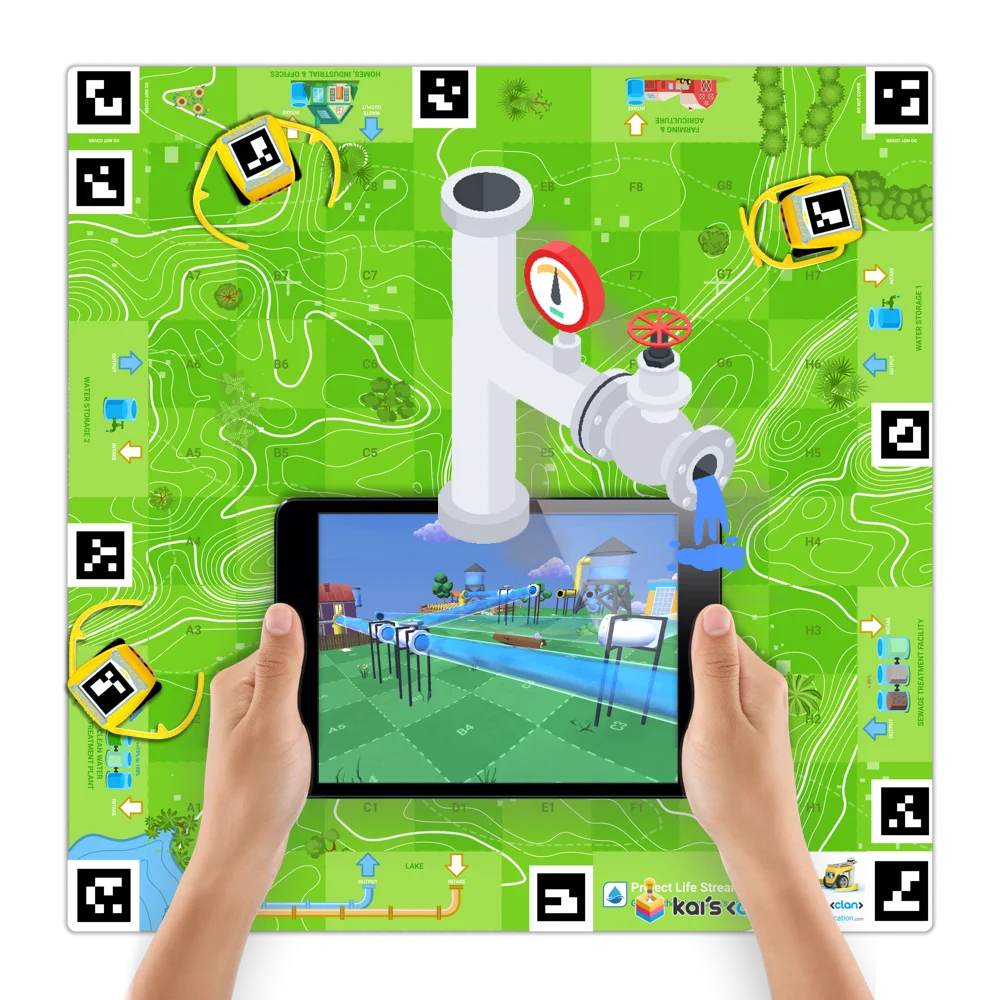
On the Water Cycle Mat, students explore:

  • Urban water collection, purification, and distributionKaiLab AR VR Water Cycle Adventure Mat


  • Wastewater treatment and reuse
  • Weather-driven decision-making


  • Disaster scenarios like floods, droughts, and fires


This opens powerful conversations about:

  • Climate resilience


  • Environmental engineering


  • Town and city planning


  • Public health infrastructure


When students connect these systems to real disasters, learning stops being theoretical. It becomes urgent. And memorable.

Rescue Run Mat: Robotics, Ethics, and Emergency Response

After devastating bushfires in Australia, students asked a simple but powerful question:

Why can’t robots help more?KaiLab AR VR Adventure Mat

The Rescue Run Mat gives educators a safe, structured way to explore that conversation.

Students work through:

  • Search-and-rescue navigation

  • Hazard avoidance

  • Time-critical decision-making

  • Human vs robotic roles in emergencies

It blends robotics with ethics, design constraints, and emergency management grounded in real events, without becoming overwhelming.

The lesson plans guide both the technology and the discussion.

IoT, Sensors, and Data: Where It All Comes Together

Across KaiLab, students work with up to 28 sensors, collecting real-time data like:

  • Distance and proximity

  • Light and temperature

  • Motion and orientation

This is where Industry 4.0 stops being a buzzword.

Students collect data → Analyze it → Make evidence-based decisions → Work in teams → Debug. Improve. Repeat.

No one student has all the answers and that’s the point.

Built With (and For) State STEM & Workforce Ecosystems

CTE doesn’t live in isolation. Neither does KaiLab.

We work closely with STEM ecosystems and workforce organizations across states like Colorado, Utah, Florida, and Idaho, where education, industry, and economic development are deeply connected.

These partnerships help schools:

  • Align learning with real workforce demand

  • Expose students to emerging career pathways earlier

  • Connect classroom projects to job-ready skills

Because preparing students for the future isn’t just about teaching tools, it’s about teaching relevance.

Why KaiLab Works for Middle to High School CTE

KaiLab hits the sweet spot schools are looking for:

  • Middle to high school ready
  • Project-based and career-connected
  • Aligned to modern CTE priorities
  • Scales from intro to advanced pathways
  • Bridges CS, engineering, and real-world careers

CTE funding is ready.
Students are ready.

There’s never been a better time to help learners see themselves in the future workforce by letting them build it first.

Are you a teacher?

Unlock exclusive educators savings.