From First Code to Future Career
What Is Kai's Education?
Building a Learning Journey from First Code to Future Career
Kai’s Education is a K–10 ecosystem building a learning journey from screen-free coding to career-ready STEM, making computational thinking accessible for all.
When I talk with teachers and district leaders, I hear many of the same challenges.
They want students to be ready for a world shaped by AI, robotics and automation, but they do not want five-year-olds spending their entire day staring at another screen.
They want to introduce coding and computational thinking earlier, but many elementary teachers quite rightly say, “I’m a math teacher. I’m not a computer science teacher.”
They want to invest in STEM, but they also need that investment to support the curriculum they are already responsible for teaching.
And increasingly, they are asking how technology can work for every learner. Not just the student who already loves coding. Not just the student who can see the screen, read the instructions quickly and immediately understand an abstract programming environment.
Those conversations are a big part of how I think about Kai’s Education.
People often describe us as a robotics company.
We are, but I think that description misses the point.
We are building a learning journey.

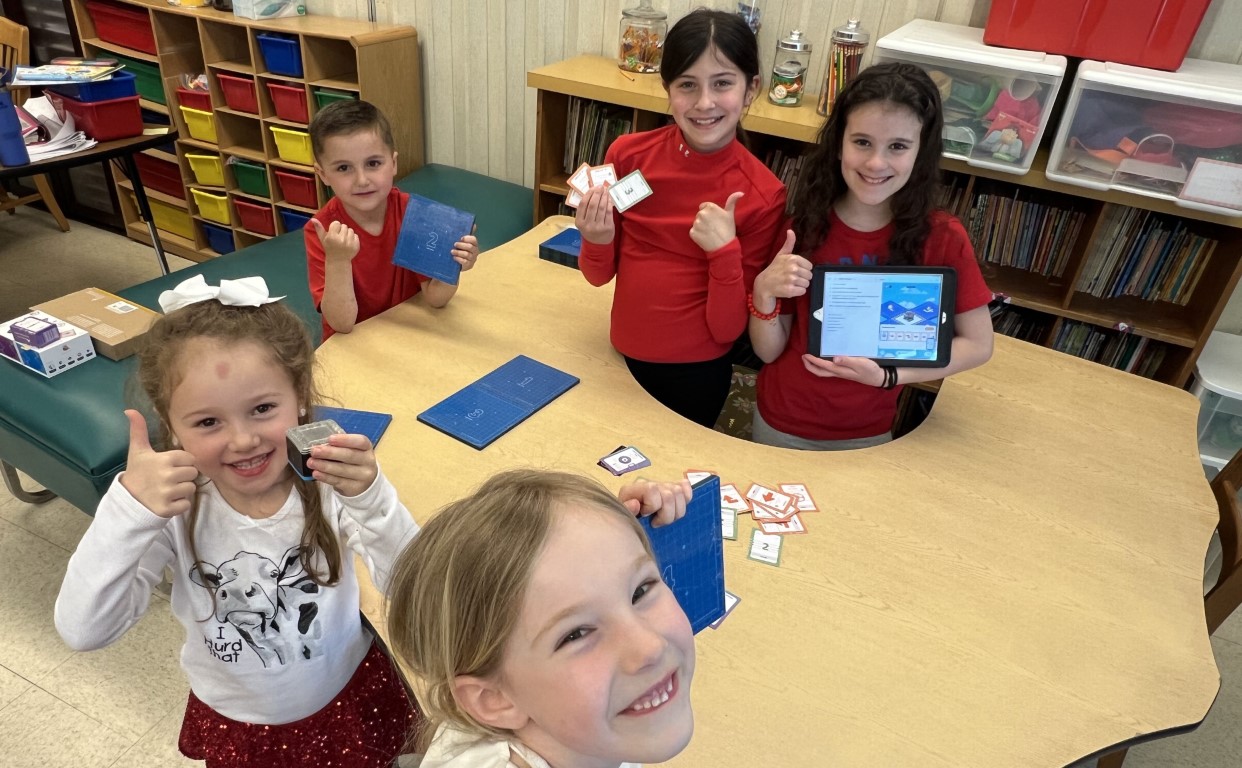
A child can start with a physical coding card and a KaiBot on a classroom table. That simple interaction starts to develop sequencing, logic and problem solving. As the student grows, those ideas become computational thinking, Blockly and Python. Later, they can take those foundations into KaiLab and start applying them to robotics, sensors, data, automation, smart cities and real-world challenges that begin preparing them for CTE pathways and the workforce.
The robot changes.
The complexity changes.
But the thinking builds from one experience to the next.
That is the Kai’s Education ecosystem.
It starts with learning how to think
Why I believe computational thinking needs to start young
When people hear “coding,” they often imagine students sitting in front of computers writing lines of code.
I think we need to go back one step.
Before we teach children the language of coding, we need to teach them the thinking behind it.
Can you break a problem into smaller parts?
Can you spot a pattern?
Can you create a sequence?
Can you make a prediction, test it and work out why it did not behave the way you expected?
Can you change your solution and try again?
That is computational thinking.
And none of it requires a young child to start with Python.
This is why KaiBot begins physically.
A student lays down coding cards, creates a program and lets KaiBot read it. The robot moves. The student immediately sees whether their thinking worked.
If KaiBot turns left when they expected it to turn right, there is nowhere for the mistake to hide.
They look at the cards.
They think.
They change something.
They run it again.
We call that debugging in computer science, but to a young learner it is simply: “That didn’t work. Why?”
That question is incredibly powerful.
This is where the foundation of our ecosystem begins.
Our learning cycle keeps bringing students back to the thinking.

As we developed more lessons and resources, we realised there was a very natural cycle happening across the best learning experiences.
Students first experience something.
Then they make sense of it.
They apply what they have learned.
They begin designing something themselves.
And eventually they implement, test and communicate their solution.
That became the basis of the Kai’s Education Learning Cycle:
Experience ➨ Make Sense ➨ Apply ➨ Design ➨ Implement
I like this cycle because the technology is not the hero.
The thinking is.
At first, the teacher provides more structure. Students explore, notice patterns and make predictions.
Then the teacher gradually gives more responsibility to the students.
Instead of us always saying, “Solve this challenge,” the student eventually gets to ask, “What challenge can I create?”
That move from consumer to creator is important.
We want students to reach the point where they are not simply following instructions. They are designing the instructions.
That philosophy runs through KaiBot, Kainundrum, our curriculum resources and eventually KaiLab.
KaiBot is where we build the foundation
Screen-free first does not mean screen-free forever
One thing I want to make very clear about KaiBot is that we are not anti-screen.
We are pro-progression.
There is a time for tactile learning and there is a time for digital learning.
There is a time for coding cards and there is a time for Blockly and Python.
The important part is the order.
Young students can start with something physical and concrete. They can touch the program, move the cards and see their algorithm laid out in front of them.
Once they understand the idea, we can gradually increase the abstraction.
Students can move into Kainundrum, where they solve digital mazes and challenges. They can begin working with Blockly. Later, they can progress into Python.
So the journey is not simply:
Screen-free ➨ Blockly ➨ Python
There is a very important stage in the middle.
Screen-free ➨ Computational thinking ➨ Blockly ➨ Python ➨ Applied problem solving
KaiBot gives us a way to teach those fundamentals before syntax becomes the focus.
Students learn sequencing, decomposition, pattern recognition, algorithms, logic, testing, debugging and iteration.
Those are not simply coding skills.
They are thinking skills.
And that is why we can use KaiBot in far more than a computer science lesson.
The robot should support the curriculum, not compete with it
One of the mistakes I think educational technology companies make is asking teachers to create an entirely new subject around the technology.
Teachers already have enough to teach.
Our approach is different.
Start with what the teacher is already trying to achieve.
Then ask whether the robot and computational thinking can make that learning more visible, more engaging or easier to understand.
That might be mathematics.
It might be literacy.
It might be science.
It might be social-emotional learning.
It might be a pure computational thinking lesson.
KaiBot becomes the tool, rather than the curriculum objective.
That distinction has become particularly clear through our work with Math in Action.
Math in Action showed us what this can look like in a core classroom
Start with the mathematics
Math in Action by Project {FUTURE}, authored by Heather Peters and Heidi Williams, is one of my favorite examples of what happens when computational thinking is integrated properly.
The philosophy is wonderfully simple.
Start with the mathematics.
Do not start by saying, “Today we are going to use a robot.”
Start with the mathematical idea the teacher needs students to understand.
Then use patterns, algorithms, decomposition, testing and debugging where they help make that mathematical thinking visible.
The program works across K–5 concepts including number sense, addition and subtraction, arrays, multiplication and division, inequalities, factor pairs and input/output relationships. At the same time, students are developing decomposition, pattern recognition, abstraction and algorithmic thinking.
What I love about this is that a child does not need to know they are “doing computer science.”
They may be trying to solve a multiplication problem.
But as they recognize a repeating pattern, create an algorithm, test it using KaiBot, discover an error and change their approach, they are learning mathematics and computational thinking at the same time.
The subjects are supporting one another instead of competing for classroom time

Watching teachers experience it changed the conversation
We had a chance to see this ourselves at the 2026 WeTeach Conference, where around 50 teachers worked with Math in Action and KaiBot.
What stood out to me was that we did not need to turn the session into robot training.
The teachers became the students.
They explored the mathematics. They made predictions. They worked with patterns. They tested algorithms. They debugged their thinking.
Then we were able to have the more important conversation:
“How could you use this in the math you already teach?”
That is the opportunity.
We do not need every elementary math teacher to suddenly become a computer science specialist.
Computational thinking already exists inside mathematics.
We can help teachers recognize it and make it visible.
A separate four-day Math in Action institute in 2026 gives us some evidence of this shift. Analysis of 44 valid post-workshop Q-sorts found that participants more strongly connected coding, patterns and algorithms with deeper mathematical learning. They also became less likely to view computational thinking as something that necessarily takes instructional time away from mathematics.
For me, that is a significant outcome.
Because if computational thinking is always treated as “one more thing,” it will struggle to scale.
If it strengthens the mathematics teachers are already teaching, we have a very different conversation.
And mathematics is only one example.
Across the Kai’s Education ecosystem, we also use KaiBot in literacy, science, social studies, SEL and cross-curricular STEM. Resources such as Market Math, Literacy Kitchen and Dragon of Disengagement all come from the same belief.
Do not force coding into the curriculum.
Use computational thinking where it makes the curriculum stronger.
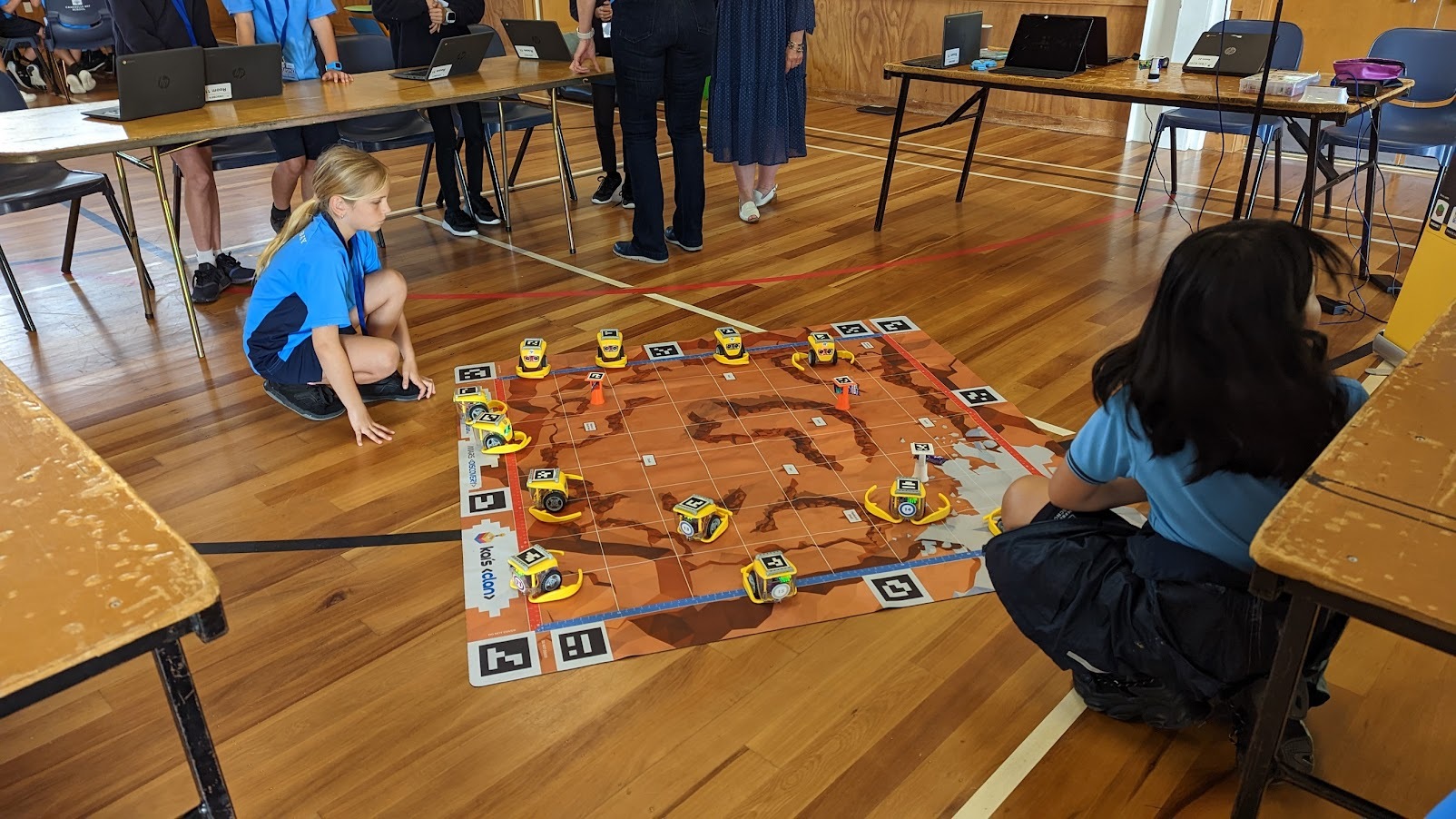
KaiLab is where we take those foundations into the real world
The question gets biggers as the students get older
At some point, students need to move beyond learning the foundations and start applying them.
That is where KaiLab comes in.
With KaiBot, a student might be asking:
“How do I program my robot to reach that tile?”
That is exactly the right question when we are teaching sequencing, logic and algorithms.
But as students get older, I want the question to become bigger.
“How can our team use robotics, coding, sensors and data to solve this problem?”
That change is at the heart of KaiLab.
KaiLab takes the computational thinking students have developed and applies it across collaborative robotics, Blockly and Python, sensors, IoT, data, augmented and virtual reality and digital design.
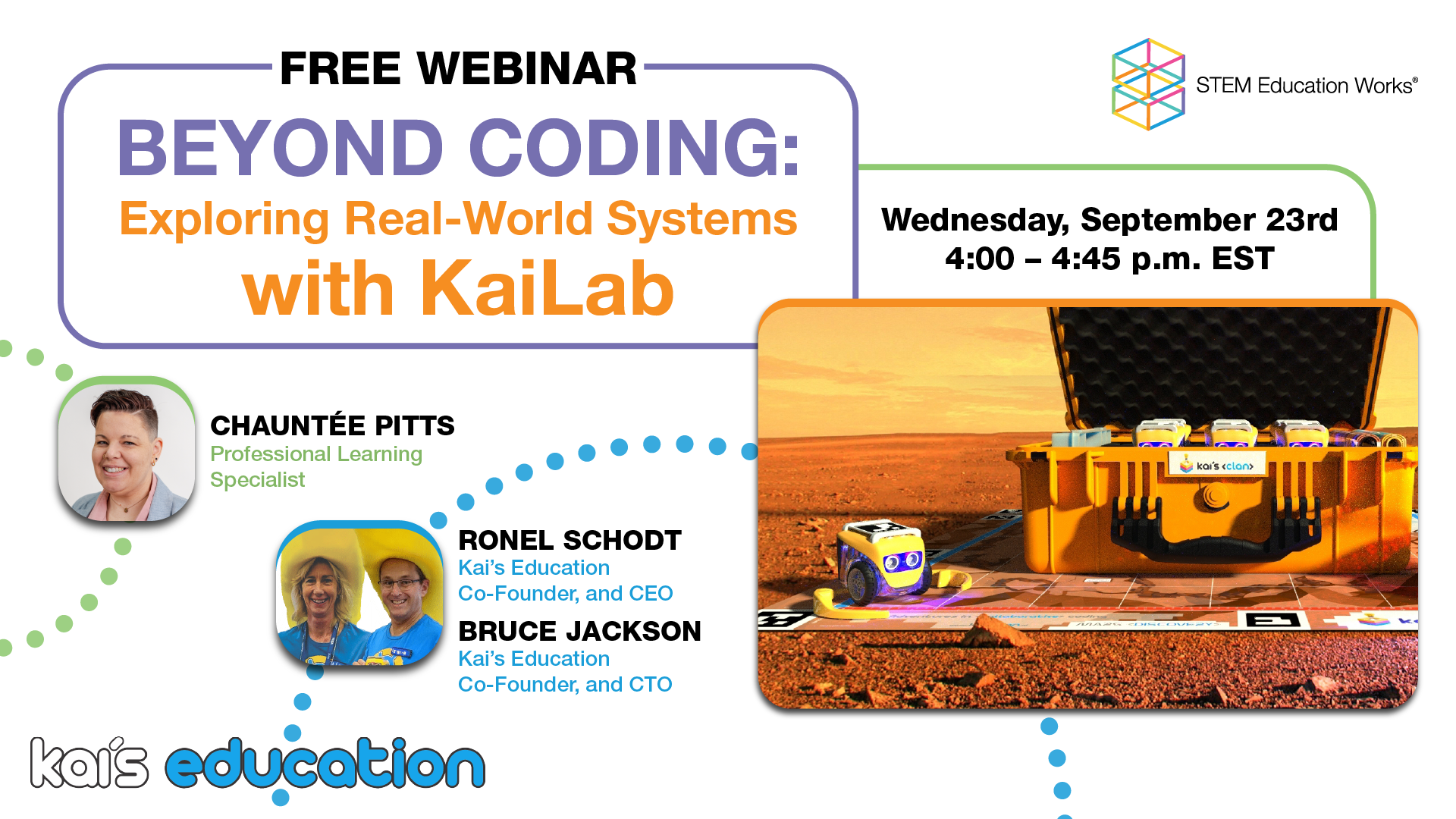
Now we can give students a Mars mission.
They need to navigate, plan, communicate and solve problems.
We can give them a Smart City and ask them to think about energy, transport, sustainability, environmental monitoring and the data a future city might need.
We can create an Automated Warehouse where students begin exploring robotics, sensors, product movement, logistics and automation.
Suddenly the learning starts looking very different from a traditional coding exercise.
It starts looking like the world students will eventually work in.
This is where CTE readiness begins to make sense
When we talk about CTE readiness, I am careful about the language.
KaiLab is not a CTE certification.
We are preparing students for those pathways.
The World Economic Forum’s Future of Jobs Report 2025 identified analytical thinking as the most widely cited core skill among employers, while technological literacy remains one of the major skills employers say they need.
That makes sense to me.
We cannot know every technology today's students will use ten years from now.
But we can help them become comfortable with technology.
We can help them understand systems.
We can teach them to work with data.
We can give them experience in robotics and automation.
We can teach them to collaborate.
And above all, we can teach them how to approach a problem they have never seen before.
That is why I see the progression this way:
KaiBot builds the foundation. KaiLab turns that foundation into career-connected learning.
The student who began by arranging coding cards is now thinking about robotics, automation, sensors, smart infrastructure, manufacturing, logistics or engineering.
It is one connected journey rather than a series of unrelated STEM products.
If we say every learner, we have to mean every learner.
Accessibility cannot be something we add at the end
Another question has shaped KaiBot from very early on:
Who gets to participate?
It is easy to create exciting technology and then discover that some students cannot actually access it.
I do not think that is good enough.
That is why KaiBot can be programmed screen-free.
It is why we developed Braille coding cards.
It is why we have auditory feedback and tactile learning.
The goal is not to create a completely separate robotics activity for a blind or low-vision student while everybody else in the classroom does something different.
The goal is much simpler.
Let them participate together.
Field testing involving 29 students across elementary, middle and high school settings found that 86% were rated either “Very Engaged” or “Extremely Engaged” while using KaiBot.
The students included blind and low-vision learners and students with additional needs including deaf, blindness, autism, ADHD, CVI and complex disabilities.
For me, the most important word in those results is not technology.
It is participation.
Accessibility should not mean that a student can technically operate a product.
It should mean they are genuinely part of the learning.
We also need evidence that goes beyond excitement
I love watching students light up when the robots come out.
But engagement cannot be our only measure of success.
District leaders need to know whether a resource can contribute to serious academic goals.
That is why our case studies are becoming an increasingly important part of the Kai’s Education story.

Cynthia Lloyd, Elementary STEM Specialist, described what she had seen in classrooms as “complete engagement.”
Participating implementations also reported Acadience Math gains of between 10% and 24%, with some classrooms recording growth rates up to four times the national average.
I think it is important that we are responsible about those figures.
A robot does not single-handedly cause academic growth.
Teachers matter.
Implementation matters.
Instructional time matters.
The curriculum matters.
Students themselves matter.
What those results demonstrate is something different and, in my view, more useful.
Hands-on computational thinking does not have to sit outside serious academic learning as a Friday-afternoon enrichment activity.
It can be part of it.