Are We Really Including
Every Student?
Rethinking Special Education, Neurodiversity and Engagement
By Ronel Schodt, CEO, Kai's Education

I have been thinking a lot about special education lately.
Not just about special education as a department, a funding category or a group of students. I have been thinking about what we actually mean when we say a classroom is inclusive.
Because there is a big difference between having a student in the classroom and having that student genuinely involved in the learning.
A student can be sitting alongside everyone else and still be completely excluded from what is happening.
That brings me to a question I think we need to ask more often:
Are we measuring inclusion by where a student sits, or by whether they are actually learning, participating and engaged?
The more I look at what is happening around the world, the more I think this is becoming one of the defining education questions of our time.
First, Who Are We Actually Talking About?
Even the language gets confusing.
We talk about students with special needs. Students with disabilities. SEND. Special education. Learning support. Additional needs. Neurodivergent students.
They are not all the same thing.
A student can have a disability without requiring special education.
A student can be neurodivergent without identifying as disabled.
And a student can struggle significantly in a conventional classroom without qualifying for formal special education support.
Take ADHD.
A student with ADHD may be incredibly creative, technically capable and a brilliant problem-solver. But put that same student through a 40-minute teacher-led lesson where they are expected to sit still, listen and process information in one particular way and suddenly we describe them as disengaged.

Maybe they aren't disengaged from learning.
Maybe they are disengaged from the way we are asking them to learn.
The same applies to dyslexia, autism, dyscalculia and many other neurological differences.
A dyslexic student may have exceptional mathematical reasoning but struggle to read the instructions.
An autistic student may understand coding beyond their grade level but become overwhelmed by the sensory environment around them.
A blind student may understand computational thinking perfectly but be unable to access the visual coding interface the rest of the class has been given.
These students don't necessarily have a problem with learning.
Sometimes learning has a problem with them.
And that is a very different conversation.
Around the World, Special Education is Changing
What makes this particularly interesting right now is that countries around the world are wrestling with the same problem in very different ways.
The United States has just passed 50 years of IDEA, the Individuals with Disabilities Education Act.
That legislation fundamentally changed education for children with disabilities. Before the legislation that became IDEA, many children with disabilities could simply be excluded from public education.
Today, more than eight million infants, toddlers and students receive services under IDEA.
That is extraordinary progress.
But the United States is now going through another major change.
In 2026, parts of federal special education administration are being reorganized, with the Department of Health and Human Services becoming involved in special education and rehabilitative services and the Department of Justice becoming involved in areas including civil-rights enforcement.
There are arguments for reducing bureaucracy. Families and disability advocates also have understandable concerns about protecting educational expertise and the rights families spent decades fighting to establish.
For me, though, there is an even bigger question.
Whatever department administers the system, what happens when the child walks into the classroom?
A legal right to education doesn't automatically make the lesson accessible.
England is facing another version of the same challenge.
Its SEND system has become expensive, complicated and incredibly frustrating for many families. The Government's 2026 reforms propose a stronger universal level of support in mainstream schools, followed by targeted and specialist support.
There is logic in that.
Why should a child have to fail before they receive help?
If we know classrooms contain students who learn differently, shouldn't we design the classroom to expect those differences from the beginning?
But there is also a risk.
Moving more responsibility into mainstream classrooms only works if we give teachers the resources, training, technology and specialist support to actually deliver it.
Otherwise we haven't removed the problem; we have just moved it.
Australia is having an even more difficult conversation.
The Disability Royal Commission raised serious questions about segregation and whether students with disabilities should continue being educated separately.
Some Commissioners recommended progressively moving away from segregated education. Others disagreed.
I can understand why this debate becomes emotional.
There are families whose children have profound and complex needs who value specialist schools enormously.
There are also people with disabilities who can tell us exactly what it felt like to be separated from their peers when they didn't need to be.
I don't think the answer is as simple as saying all specialist schools are wrong or all mainstream classrooms are inclusive.
New Zealand is demonstrating that tension right now.
Our Government is investing more than NZ$317 million into specialist education infrastructure, including new specialist classrooms and three new specialist schools.
Education Minister Erica Stanford has described the philosophy as: “Inclusion is choice.”
I actually think there is something important in that.
For some students, specialist education is absolutely the right environment.
But investing in specialist education cannot become an excuse for mainstream classrooms not to change.
We need both.
We need excellent specialist education for students who genuinely need it.
And we need mainstream education designed so that far fewer children are excluded simply because they learn differently.

Being in the Classroom Isn't Enough
This is where I keep coming back to engagement.
I recently watched a teacher talking about the reality of inclusion, and one thing really stuck with me.
We can put a student in a mainstream classroom.
But are they actually engaged?
That sounds simple, but think about what happens in real classrooms.
A student can sit at the same table as everyone else but be given a completely different worksheet.
A student can be given a tablet while everybody else collaborates.
An aide can sit beside a student and effectively do half the activity for them.
A student can physically attend every lesson without ever being given the opportunity to lead, solve a problem or help somebody else.
So I have started thinking about inclusion in three stages.
Presence. Participation. Engagement.
Presence means I am in the room.
Participation means I can take part.
Engagement means I am thinking, making decisions, communicating, problem-solving and contributing.
That third stage is where learning really starts.
Mike Wood Make me Think Differently About Accessibility
This is also why I really value the perspective of people who work in accessibility every day.
Mike Wood from the American Printing House for the Blind has spent much of his career working at the intersection of accessibility, technology and education.
Something Mike has said really resonates with me: “Accessibility is essential in the learning process.”
Think about that for a moment.
We often talk about accessibility as compliance.
Does the application work with a screen reader?
Do we have a Braille version?
Is there an alternative format?
Can the teacher's aide help?
Of course those things matter.
But Mike's point takes us somewhere further.
Accessibility isn't simply about whether a student can technically access something.
It is about whether they can learn from it.
Can the student explore independently?
Can they make choices?
Can they make a mistake?
Can they work out what went wrong?
Can they try again?
Can they contribute something to their group?
That is a much higher standard.
And I think it is the standard educational technology companies should be designing toward.
Ben Davisson Reminded Us Why Peers Matter
Then there is Ben Davisson.
Ben is the Statewide Visually Impaired and Deafblind Specialist at Education Service Center Region 11 in Texas.
He works directly with teachers and students and understands the reality of assistive technology in classrooms.
He has also worked with KaiBot.
One thing Ben said has stayed with me:

“The KaiBot teaches my students a lot of social skills. KaiBot helps us teach with peers.”
With peers.
Those two words are incredibly important.
Because education isn't only about curriculum.
Children learn from children.
They explain things to one another. They negotiate. They take turns. They disagree. They solve problems together.
They laugh when something goes completely wrong. They debug it.
And they celebrate when it finally works.
Ben has also said:
“It teaches them all sorts of skills. Math, reading, coding, typing, Braille literacy, you name it.”
That is the kind of inclusion I want us to talk about more.
Not the student with a disability doing the “accessible activity” while everyone else does the real lesson.
Everyone working on the problem together.
And sometimes something even more powerful happens.
The student everybody expected to need help becomes the person helping everybody else.
Think about what that does to a child's confidence.
What If We Started Measuring Independence?
We spend a lot of time measuring whether students with disabilities receive support. I think we should also measure how much independence our support creates.
Can the student begin the activity themselves?
Can they understand the instructions?
Can they manipulate the materials?
Can they recognize when something has gone wrong?
Can they fix it?
Can they explain what they did?
And here's my favorite question: Can they help another student? That changes everything.
The blind child is no longer automatically the student receiving help. They may be the strongest coder in the group.
The child with ADHD might spot the solution everyone else missed.
The dyslexic student might have extraordinary spatial reasoning.
The autistic student might recognize a logical pattern nobody else sees.
Suddenly we aren't talking about deficits. We're discovering strengths.

This Story Is Personal for Kai's Education
This brings me to Kai's Education and why this subject means so much to us.
Our co-founder and the inventor behind KaiBot, Bruce Jackson, describes himself pretty simply.
Half-blind. ADHD. And a geek.
School wasn't exactly designed for that combination. Bruce has spoken openly about being the “naughty” student. ADHD wasn't understood the way it is today, and if you struggled to sit still or engage in the expected way, the assumption was often that the student was the problem.
But give Bruce technology and something changed.
Give him something to build. Something to code. Something to take apart.
A problem nobody had given him the answer to. He was engaged. That experience has influenced a lot of what we do today.
Because it raises a question that I think about constantly: How many children are we deciding cannot learn when we simply haven't found the way they learn?
KaiBot Wasn't Created as a Special Education Robot
This is an important part of our story.
KaiBot didn't begin as a special education product.
The original idea was about getting children coding without making another screen the starting point.
What if a child could physically build their code?
Put down a card. Add another. Change the sequence.
Run the robot. It doesn't work.
Great.
Why? Find the bug. Move a card.
Try again.
Suddenly computational thinking becomes physical. But as we worked with more teachers and students, we started asking another question.
Who are we unintentionally excluding?
If coding depends entirely on a screen, what happens to the student who cannot see it?
If the instructions depend entirely on reading, what happens to the struggling reader?
If everything requires precise interaction with a digital interface, who are we leaving behind?
And if our solution is to create a completely separate product for those children, is that actually inclusion?
Those questions changed KaiBot.
We developed tactile coding experiences.
- Braille coding cards.
- Reader functionality.
- Auditory feedback.
- Screen-free learning.
- Immediate feedback when the code doesn't work.
- Physical coding that can progress into Blockly and Python when the student is ready.
But the most important outcome isn't any individual feature.
It is that students can use these things together.
Our Partnership With APH Is About Breaking Down Barriers
This is why our relationship with the American Printing House for the Blind means so much to us.
APH has been breaking down barriers to education for people who are blind and have low vision for more than 160 years.
For us, working with an organization with that history and expertise reinforces something we believe deeply.
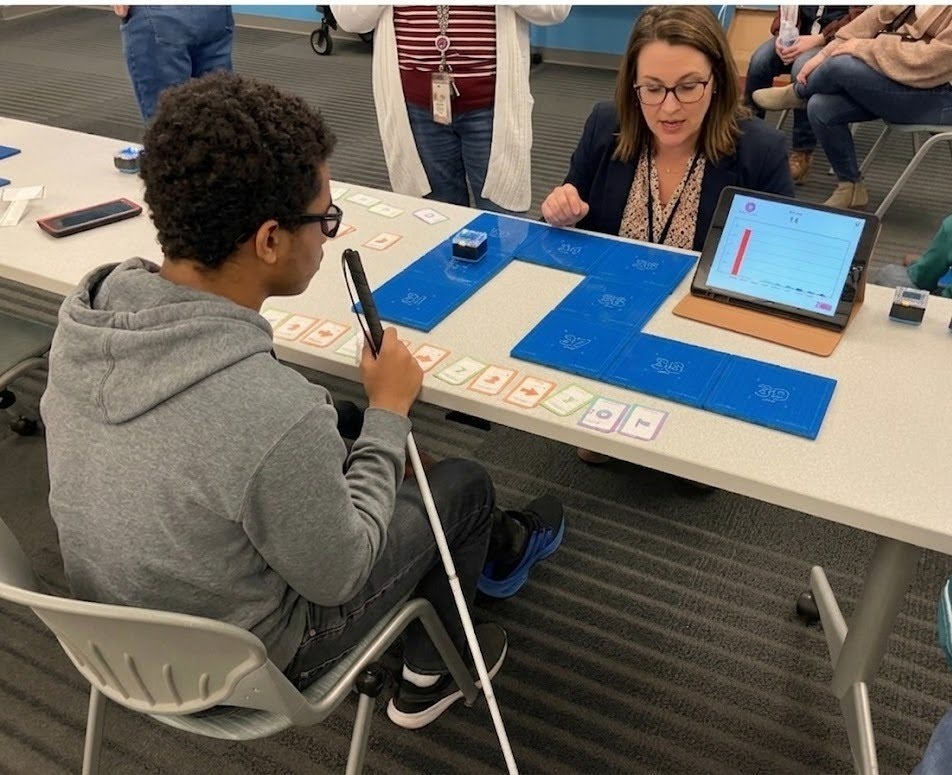
Accessible STEM should not be a separate version of STEM.
STEM should be accessible.
We want a blind student coding alongside a sighted student.
We want the neurodivergent learner solving the same problem.
We want students to touch, listen, read, build, and experiment.
We want them helping one another.
And yes, we want them making mistakes.
Because debugging isn't failure.
It is learning.
Our job as an education technology company isn't to remove every challenge.
It is to remove the barriers that prevent students from getting to the challenge.
There is a huge difference between those two things.
Universal Design Can Also Help Our Teachers
There is another side to this conversation that doesn't get enough attention.
Our specialist educators are stretched.
Teachers of students with visual impairments, special educators, assistive technology specialists, therapists and teacher aides have expertise that schools desperately need.
But how much of their time is spent compensating for resources that weren't accessible in the first place?
Changing worksheets.
Converting content.
Explaining visual material.
Helping a student operate technology that wasn't designed for them.
Sitting alongside a student simply because the activity cannot be completed independently.
What if more of our classroom resources were accessible from the beginning?
The specialist doesn't become less important.
They become more valuable.
They can spend their time on Braille literacy, assistive technology, orientation and mobility, communication, individual interventions and complex learning needs.
That is why Universal Design for Learning is so important.
UDL isn't about treating everybody the same.
It is almost the opposite. It accepts that students learn differently and designs different ways of accessing the same learning objective from the beginning.
One student sees it.
Another hears it.
Another touches it.
Another needs to move while doing it.
Different pathways, shared learning outcomes.
Where Do We Go From Here?
When I look at what is happening in the United States, England, Australia and New Zealand, I don't think any country has completely solved this.
And I don't think there is one model that works for every child.
We need specialist schools.
We need special educators.
We need IEPs, EHCPs and individualized support.
We need assistive technology.
But we also need to stop designing mainstream education around an imaginary average student and then wondering why so many children don't fit.
We need to intervene earlier; train and support teachers.
We need accessible curriculum resources; technology designed around different ways of learning.
And we need to listen to students, families and specialists.
Most importantly, I think we need to change what we measure.
Don't just ask: Was the student in the classroom?
Ask: Did they participate?
Were they engaged?
Did they make decisions?
Did they solve a problem?
Did they work with their peers?
Did they make a mistake and try again?
Did they experience independence?
Did they get the opportunity to help someone else?
Did they feel like they belonged?
From Access to Empowerment
Maybe this is where the future of special education needs to go.
Access is the starting point.
Inclusion is the environment.
Engagement is the experience.
Independence is the capability.
Empowerment is the outcome.
I love that progression because ultimately this isn't about special education versus mainstream education. It isn't about disabled students versus non-disabled students.
And it certainly isn't about technology replacing teachers or specialists.
It is about designing education around the reality that children are different.
At Kai's Education, we don't want accessibility to be a feature printed on the side of a box. We want it embedded in the learning experience.
Because the goal isn't simply to make a robot accessible.

The goal is the moment when a student who has always waited for somebody to help them builds a program themselves, runs it, discovers it doesn't work, figures out why, fixes it and then turns to the student beside them and says:
“I've got it. Let me show you.”
That is engagement.
That is independence.
That is belonging.
And that is empowerment.
Maybe instead of continually asking which students belong in special education, we should start with a much simpler question:
What barrier is stopping this student from learning, and what can we do to remove it?
I think that is a much better place to start.